
URL shorteners now sit at the center of a market worth hundreds of millions of dollars, powering billions of clicks and QR scans every year.
Below are the most current, sourced statistics on link shortening, click behavior, QR codes, and where the industry is headed in 2026.
Key Takeaways
- Market research firms value the URL shortening industry anywhere from roughly $300 million to over $1 billion depending on scope, growing at a 12-20% CAGR.
- Branded short links consistently outperform generic ones on click-through rate, though exact lift varies by channel and study.
- Around 2.2 to 2.9 billion people worldwide now scan QR codes, with more than 100 million Americans expected to scan one in 2026.
- Zero-click search has reached a record high, with over 68% of US Google searches in 2026 ending without a click to any website.
- goo.gl, once one of the top three shorteners globally, is now defunct after Google’s 2025 shutdown, opening room for other providers.
How Big Is the URL Shortener Market?
Market size estimates vary widely depending on what a research firm counts as part of the “URL shortening” category.
Firms that measure basic link shortening alone report smaller figures.
Firms that include the full link management stack, branded domains, analytics, QR codes, and API access, report considerably larger ones.
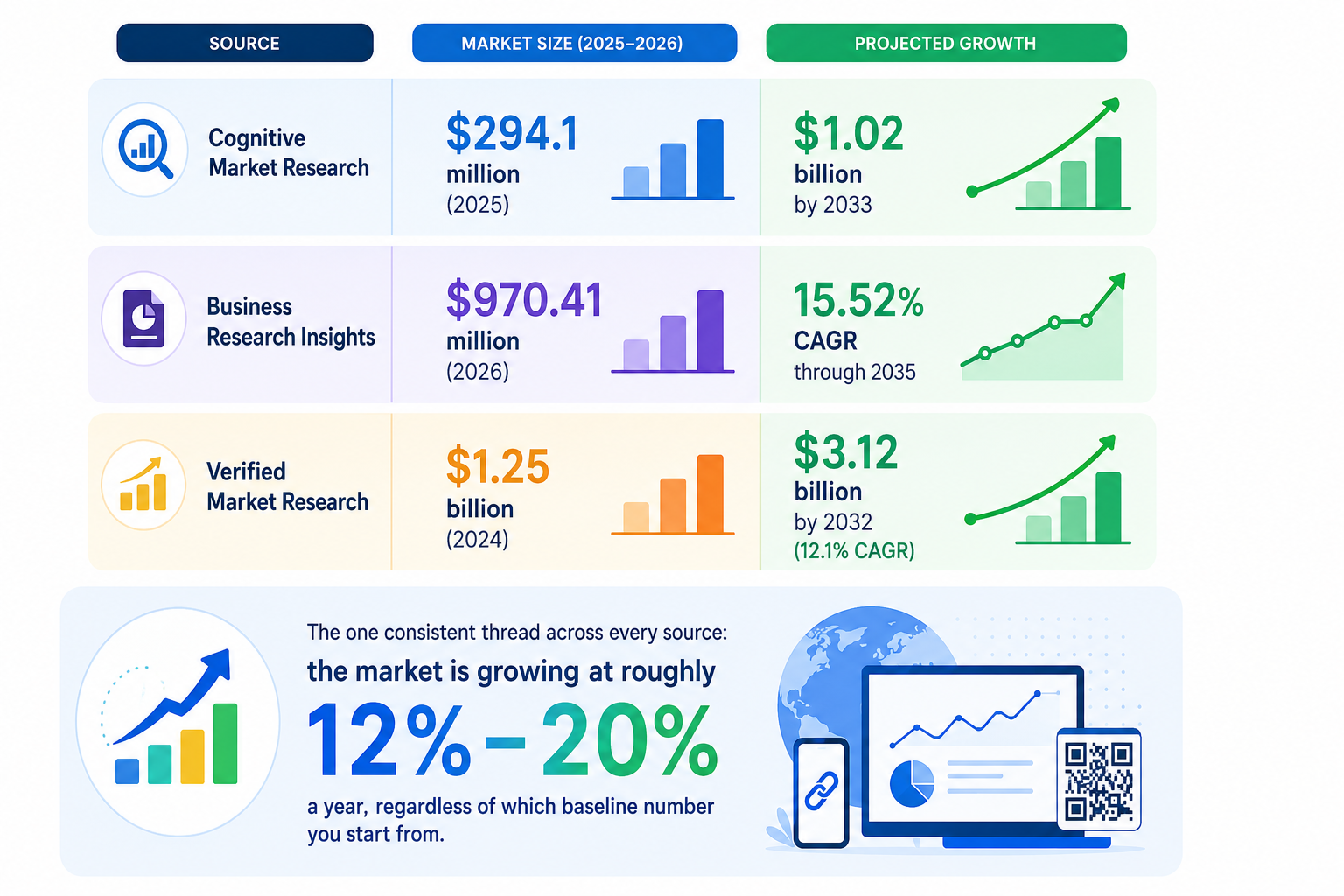
| Source | 2025-2026 Market Size | Projected Growth |
|---|---|---|
| Cognitive Market Research | $294.1 million (2025) | $1.02 billion by 2033 |
| Business Research Insights | $970.41 million (2026) | 15.52% CAGR through 2035 |
| Verified Market Research | $1.25 billion (2024) | $3.12 billion by 2032 (12.1% CAGR) |
The one consistent thread across every source: the market is growing at roughly 12-20% a year, regardless of which baseline number you start from.
That’s a faster growth rate than most mature SaaS categories.
How Many Links and Clicks Happen Every Day?
Volume estimates are just as varied as market size, but the scale is consistently massive.
- URL shorteners collectively process more than 10 billion redirects a month, according to industry tracking.
- At Twitter’s peak use of URL shortening, the platform alone drove over 5 billion redirects a day through shortened links.
- By 2023, total global clicks through shortened links were estimated at 1.2 trillion for the year.
For context on how this scale developed, the 40 best link shortener tools from 2002 to 2025 traces the platforms behind these numbers, from TinyURL’s early days to today’s analytics-driven tools.
Do Branded Short Links Actually Get More Clicks?
Yes, though the exact percentage lift depends heavily on the channel, audience, and what’s being measured.
A widely cited 2018 marketing survey found branded short links increase click-through rates by up to 34% compared to generic ones.
More recent link-in-bio research found optimized setups improving CTR by as much as 350% over unoptimized baselines, though that figure reflects a broader strategy shift, not branding alone.
What drives the difference?
A short link’s domain, its slug length, whether it uses HTTPS, and the reputation of that domain all influence whether someone clicks it.
- A recognizable brand name in the URL builds trust before the click happens.
- A clean, readable slug looks less like spam than a random string of characters.
- Consistent branding across channels reinforces recognition over repeated exposure.
This is also why branded short links with a custom domain tend to outperform links on a shared, generic domain.
How Widely Used Are QR Codes Now?
QR code adoption has grown well past its pandemic-era spike into a permanent fixture of both online and offline marketing.
| Metric | Figure |
|---|---|
| Global QR code users | 2.2 to 2.9 billion people |
| Share of smartphone users who scan QR codes | ~29% |
| Americans expected to scan a QR code in 2026 | Over 100 million |
| Mobile users who have scanned at least one QR code ever | ~84% |
| Marketers who now use QR codes in campaigns | 90%+ |
| Dynamic QR code market share | ~65% |
The most common scan contexts back this up.
Surveys show people scan QR codes most often in stores and on products, at restaurants, and at live events, well ahead of scanning them on websites or social media.
That dynamic QR code share matters.
A dynamic QR code lets you change the destination after printing, which is why most marketers have shifted away from static codes entirely.
Linko’s free QR code generator supports both types across 14 formats.
How Is AI Search Changing Link Behavior?
Search itself is shifting in ways that directly affect how links get clicked, or don’t.
- Zero-click search reached 68.01% of US Google searches in early 2026, the fastest two-year acceleration on record according to a SparkToro and Similarweb study.
- That means only about 276 out of every 1,000 searches now result in a click to an actual website.
- At the same time, AI referral traffic surged 527% between January and May 2025, and visitors arriving from AI platforms convert at 4.4 times the rate of traditional organic visitors.
- Brand mentions across the web now correlate more strongly with AI citation than backlinks do, by roughly 3 to 1.
The takeaway for anyone managing links: fewer total clicks are happening on the open web, but the clicks that do happen are increasingly high-intent.
A shortened link with solid branding and tracking matters more, not less, in that environment.
What Happened to goo.gl, and What Does It Mean for the Market?
Google’s own URL shortener, goo.gl, once ranked among the top three shorteners worldwide by volume.
Google disabled new goo.gl link creation in April 2019, then set a full shutdown date of August 25, 2025, before partially reversing course days before the deadline to preserve actively used links.
The practical effect is a gap in the market that other providers have absorbed.
For the full breakdown of what happened and how to handle an old goo.gl link, see the goo.gl alternative and broken link fix guide.
Which Companies Dominate Link Shortening Today?
Market share data shows a concentrated top, followed by a long tail of specialized tools.
- Bitly holds roughly 38.3% of the URL shortener market by detected usage share.
- EepURL follows at around 15%.
- Amzn.to, Amazon’s internal shortener, accounts for roughly 10.9%.
Below that top tier, dozens of tools compete on specific strengths: bio pages, retargeting pixels, enterprise compliance, or QR code depth.
That fragmentation is part of why choosing the right URL shortener depends heavily on what you actually need it to do.
Frequently Asked Questions
How big is the URL shortener market in 2026?
Estimates range from roughly $300 million to over $1 billion depending on the research firm and what’s included in the definition. Every major source agrees the market is growing at 12-20% a year.
How many clicks happen through shortened links each day?
Industry estimates put monthly redirects through URL shorteners above 10 billion, with total shortened-link clicks reaching an estimated 1.2 trillion for 2023 alone.
Do branded short links really get more clicks than generic ones?
Yes. A widely cited study found branded short links increase click-through rates by up to 34% compared to generic domains, driven by trust and brand recognition at the moment of the click.
How many people scan QR codes worldwide?
Estimates range from 2.2 to 2.9 billion people globally, with over 100 million Americans expected to scan at least one QR code in 2026.
What is zero-click search and how does it affect link shorteners?
Zero-click search refers to searches that end without the user clicking through to any website, often because an AI Overview or featured snippet already answered the question. It reached 68.01% of US Google searches in early 2026, meaning link quality and branding matter more for the clicks that remain.
Which URL shortener has the largest market share?
Bitly leads with roughly 38.3% of the market by detected usage, followed by EepURL and Amazon’s Amzn.to shortener.
Turning These Numbers Into a Strategy
The data points in one direction: link shortening isn’t shrinking, it’s consolidating around tools that do more than shorten a URL.
Branded domains, QR codes, and analytics now decide which links actually get clicked in an increasingly zero-click search environment.
Create a free Linko account and put branded links, QR codes, and click analytics to work in one dashboard.
Comments