

A direct link sends someone straight to your OnlyFans, Fanvue, or Fansly profile in one tap.
A landing page stops them on a page you control first, then sends them onward.
Here is the honest answer: direct links convert better per click, and landing pages survive better on strict platforms.
Every extra step between the tap and your profile costs you subscribers, so the real question is never “which converts more.” It is “which risk can I afford right now.”
On Instagram and TikTok, that answer is usually a landing page.
On X, Reddit, and Telegram, it is usually a direct link.
This post explains why, shows you the math on what each extra click costs, and gives you a way to test it on your own traffic instead of trusting anyone’s opinion.
Key Takeaways
- Direct links win on raw conversion because one tap always beats two or three.
- Landing pages win on survival, since Meta’s rules forbid links to pornographic sites in profiles and posts.
- A landing page can also convert better on cold traffic, because tapping a button signals real intent instead of ambushing the visitor.
- Count the taps in your funnel. Going from one step to three is where most creators lose subscribers, not the page design.
- Test with a two week split on your own account, because benchmark numbers from other industries do not transfer to creator traffic.
What Is the Difference Between a Direct Link and a Landing Page?
A direct link is a short URL that redirects instantly.
The visitor taps once and arrives at your profile, with nothing in between.
A landing page is a page you own that displays your links. The visitor taps your bio link, reads the page, then taps a button to reach your profile.
That is two taps minimum, and often three once an age confirmation appears.
Both can live on your own branded domain. The difference is not the domain, it is what a scanner sees when it opens the URL.

| Factor | Direct link | Landing page |
|---|---|---|
| Taps to destination | 1 | 2 to 3 |
| What a moderation bot sees | A redirect to your creator platform | A page with buttons |
| Age warning possible | No | Yes |
| Visitor knows where they are going | Not until they arrive | Yes, before tapping |
| Room for multiple offers | No, one destination | Yes, free page, socials, tips, custom content |
| Retargeting pixel placement | Fires on the redirect | Fires on page view, with dwell time |
| Best fit | Warm traffic on permissive platforms | Cold traffic on strict platforms |
If you are still deciding what belongs on that page at all, our complete guide to link in bio pages covers the structure before you optimize the routing.
Which One Actually Converts Better?
Per click, the direct link wins.
There is no page to read, no button to find, and no second decision to make.
But raw click-to-destination rate is the wrong scoreboard, because it ignores who arrives and whether they subscribe.
Direct links win on warm traffic
Someone who has watched five of your videos and read your captions already knows what they are clicking.
Making them read a page is pure friction.
For that visitor, the page adds a decision they already made.
Landing pages can win on cold traffic
Here is the part most guides miss.
A direct link can convert worse on cold traffic, not better.
A stranger who taps a link and lands instantly on a paywalled adult profile often feels ambushed and leaves.
A visitor who taps a button labelled “Exclusive content” has told you they want it, and they arrive expecting the paywall.
The page loses raw clicks but sends better visitors.
Fewer people reach your profile, and a higher share of them subscribe.
Why Does Every Extra Click Cost You Subscribers?
Conversion through a funnel multiplies, it does not add.
Each step keeps a percentage of the previous step, so three good steps can still produce a bad result.
Work it out with your own rates. Start with 1,000 bio link taps and apply each step in order.
| Step | Direct link path | Landing page path (illustrative) |
|---|---|---|
| Bio link taps | 1,000 | 1,000 |
| Page loads and stays | Not applicable | 920 at 92% |
| Taps the profile button | Not applicable | 598 at 65% |
| Confirms the age gate | Not applicable | 538 at 90% |
| Reaches your profile | 1,000 | 538 |
Those middle percentages are placeholders, not findings. Replace them with your real analytics.
The point is the shape, not the numbers.
Adding a page and an age gate can cut the traffic reaching your profile roughly in half before anyone sees your content.
That is survivable if the page also doubles your subscribe rate by qualifying visitors.
It is a disaster if the page is slow, cluttered, or buries the button below the fold.
Where the clicks actually leak
- Slow loading, especially image heavy pages on mobile data.
- The main button sitting below the fold on a small screen.
- Too many buttons competing with the one that makes you money.
- An age gate stacked on top of a sensitive content warning, creating two modals.
- An in-app browser that breaks the login and payment step at the end.
That last one deserves attention, because it undoes everything upstream.
If your visitor arrives inside Instagram’s browser with no saved logins, the tap you fought for goes nowhere, which is why opening creator links in Safari instead of the in-app browser matters more than shaving a step.
What Do Instagram and the Creator Platforms Actually Allow?
This is where the decision usually gets made for you, so get the rules straight before optimizing anything.
What Meta’s rules say
Meta’s Community Standards on adult sexual solicitation prohibit content that asks for, offers, or provides methods of contact to acquire pornographic material, and the policy explicitly names usernames or links to pornographic websites.
Read that carefully. The restriction covers the link itself, not just your photos.
A bio link pointing straight at an adult profile is the exact pattern the policy describes. That is the compliance case against direct links on Instagram, and no shortener changes it.
What the creator platforms recommend
The platforms themselves tell you to use a page.
Fanvue’s own help documentation says Twitter and Reddit allow adult content while Instagram, TikTok, and YouTube do not, and it recommends a Linktree style tool on the platforms that forbid direct adult links so your page stays reachable from your bio without a violation.
Fansly gives similar guidance, suggesting creators group their links in one shareable spot and confirm every site they promote complies with the terms.
What a landing page does not do
A page is not a permission slip.
It does not make prohibited promotion acceptable, and it will not save an account that breaks the rules in its captions, hashtags, or images.
Moderation also looks past the visible page.
Creators report flags on pages that looked clean but exposed the destination in the page source, so treat “my page looks safe” as an assumption to verify rather than a fact.
If your account is already getting reach problems, routing is only one input. Our guide on how to avoid Instagram bans as a creator covers the content and behavior triggers this post deliberately leaves alone.
Which Should You Use on Each Traffic Source?
Match the routing to the platform’s tolerance, not to a universal rule.
The same creator should run different setups on different channels.
| Traffic source | Recommended routing | Why |
|---|---|---|
| Instagram bio and stories | Landing page | Adult links in profiles are the pattern Meta’s policy targets |
| TikTok | Landing page | Adult content links are not permitted, and link access is limited anyway |
| X (Twitter) | Direct link | Adult content is allowed, so extra steps only cost you conversions |
| Direct link | Permitted in the right subreddits, and users expect the destination | |
| Telegram | Direct link | Warm audience that already opted in |
| Email and DMs | Direct link | The most qualified traffic you have, so remove every step |
| Paid traffic | Landing page | Ad networks apply their own rules, and you need the pixel and dwell time |
One caveat on paid traffic. Ad platform policies on adult promotion are stricter than organic rules, so confirm what your specific network permits before spending.
How Do You Cut a Landing Page Down to One Real Decision?
If a page is required, the goal is not to remove it.
The goal is to make it cost as little as possible.
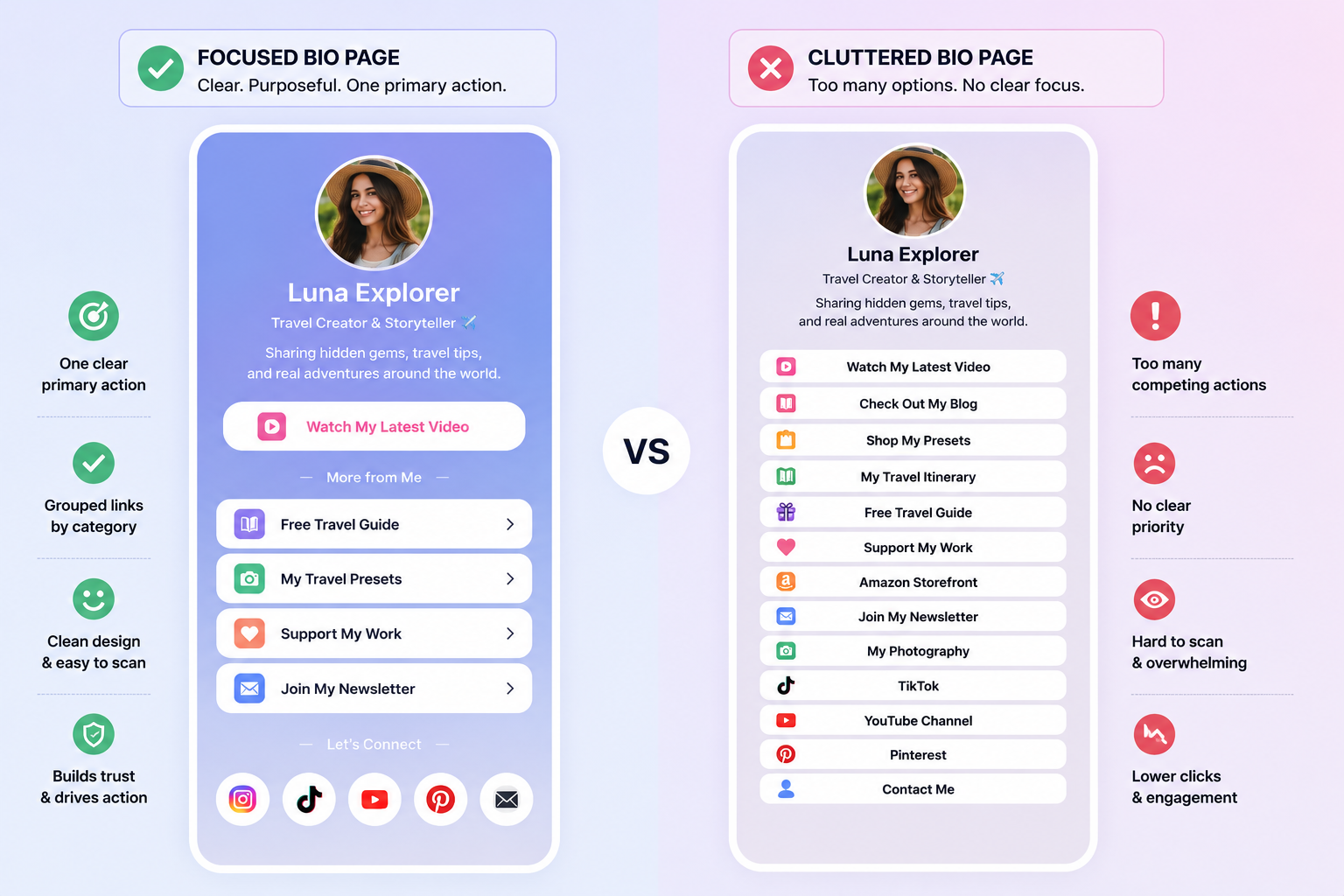
- Put the money button above the fold. Test on a small phone screen, not a desktop preview.
- Run one primary action. Move socials, tips, and free previews below the main button or remove them.
- Use one gate, not two. An age check and a sensitive content warning together create two modals and two chances to leave. Pick the one your situation requires.
- Label the button with the promise. “Exclusive content” outperforms a bare platform name because it sets the expectation the paywall will confirm.
- Fix the image weight. Large uncompressed photos are the most common speed problem on creator pages.
- Solve the in-app browser at the button. The escape needs to happen on the tap that leads to your profile, since that is where logins and payments matter.
- Keep the destination out of the visible page source where you can. Treat this as risk reduction, never as a guarantee.
A well built page with one clear button and a fast load can hold most of the traffic a direct link would have delivered.
A cluttered one throws away half of it.
How Do You Test This on Your Own Traffic?
Stop asking which converts better in general.
Measure which converts better for you, because the answer changes by niche, audience temperature, and platform.
The free method that works
You do not need a paid tool for a first answer.
- Run a direct link in your bio for seven full days and record the results.
- Switch to a landing page for the next seven days, changing nothing else.
- Compare subscribers gained, not clicks.
- Repeat once to check the result holds, since a single week can be distorted by one viral post.
Keep posting volume, content style, and story frequency steady across both weeks.
If you change three things, you learn nothing.
Why you must compare subscribers, not clicks
Clicks and subscribers move in opposite directions here, and that is the whole trap.
- A direct link inflates click counts and can lower subscribe rate.
- A landing page lowers click counts and can raise subscribe rate.
- Judging by clicks alone will always favor the direct link, even when it earns less.
Track the steps separately so you can see where the loss happens.
Tag each channel with UTM parameters so your traffic sources stay distinguishable, then read the drop between page views and destination visits rather than one blended number.
Do not trust your raw click count
Some of your clicks are not people.
Link preview crawlers, security scanners, and datacenter traffic all register, and adult niche links attract heavy automated inspection.
If bots inflate one arm of your test more than the other, your comparison breaks.
Use a tool that filters non-human clicks, and be suspicious of click spikes with no matching subscriber movement.
How Does Linko Handle Both Routes?
Most creators need both setups running side by side, on the same domain, with one place to read the results.
Linko covers both paths.
You can publish a direct short link or a Bio Page, point either at your own branded domain, and compare them in the same analytics.
The parts that matter for this specific decision:
- Deep linking for creator platforms. OnlyFans, Fanvue, and Fansly profiles are supported, so eligible links can escape restricted in-app browsers and open in Safari or Chrome.
- Shield Protection. Suspicious bots, crawlers, proxies, and datacenter traffic get a neutral page instead of your real destination. It reduces exposure to automated checks, and it is not a guarantee against moderation.
- Visitor controls on every plan. Age Restriction by date of birth, the sensitive content warning modal, and Bio Page geo and language targeting are included on all plans, including Free.
- A/B testing with traffic reports. Split traffic between destinations by percentage and read the distribution. So use the two week manual test first if you are on a lower tier.
- Human click filtering. A nine layer bot detection system means the click counts you compare are closer to real visitors.
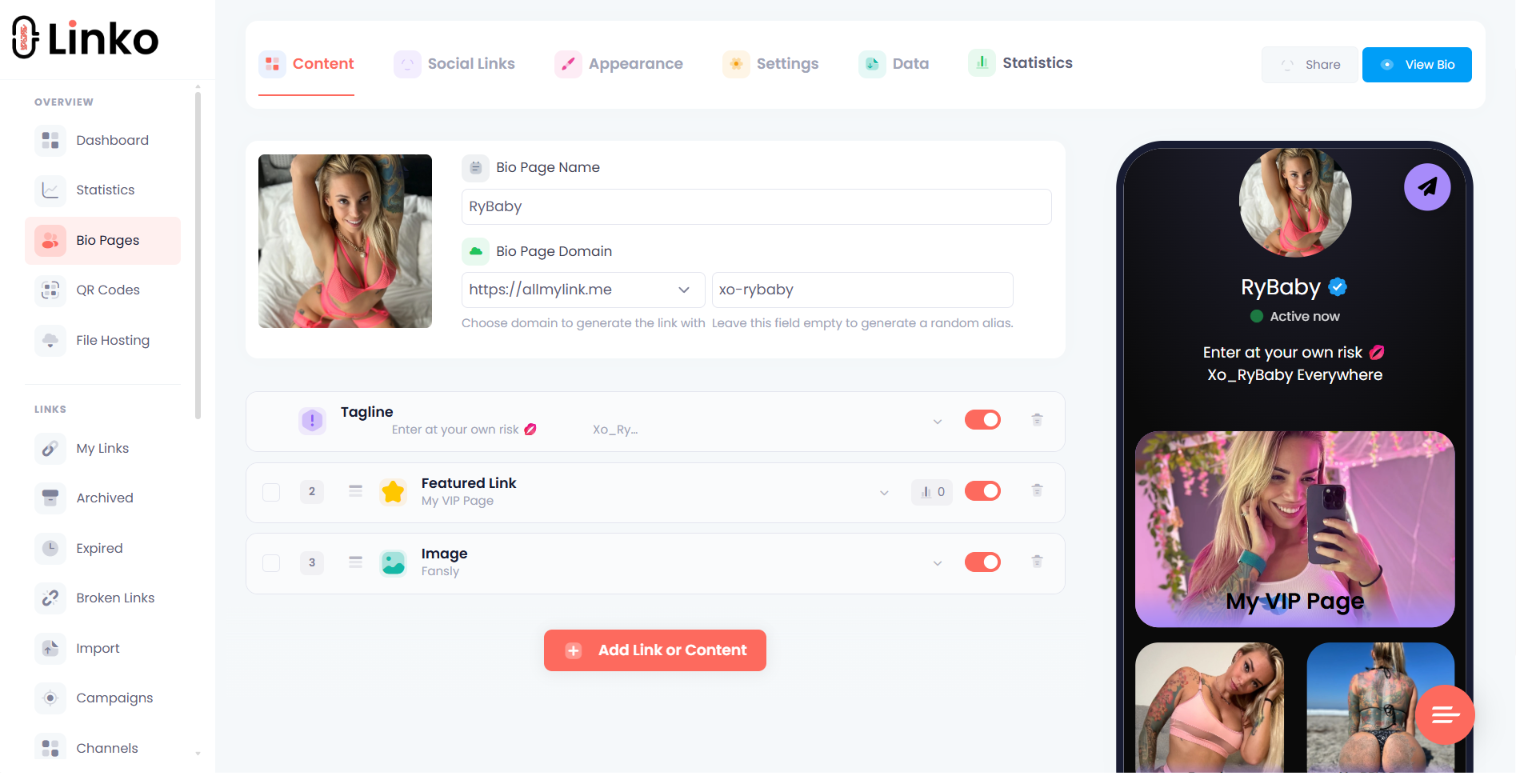
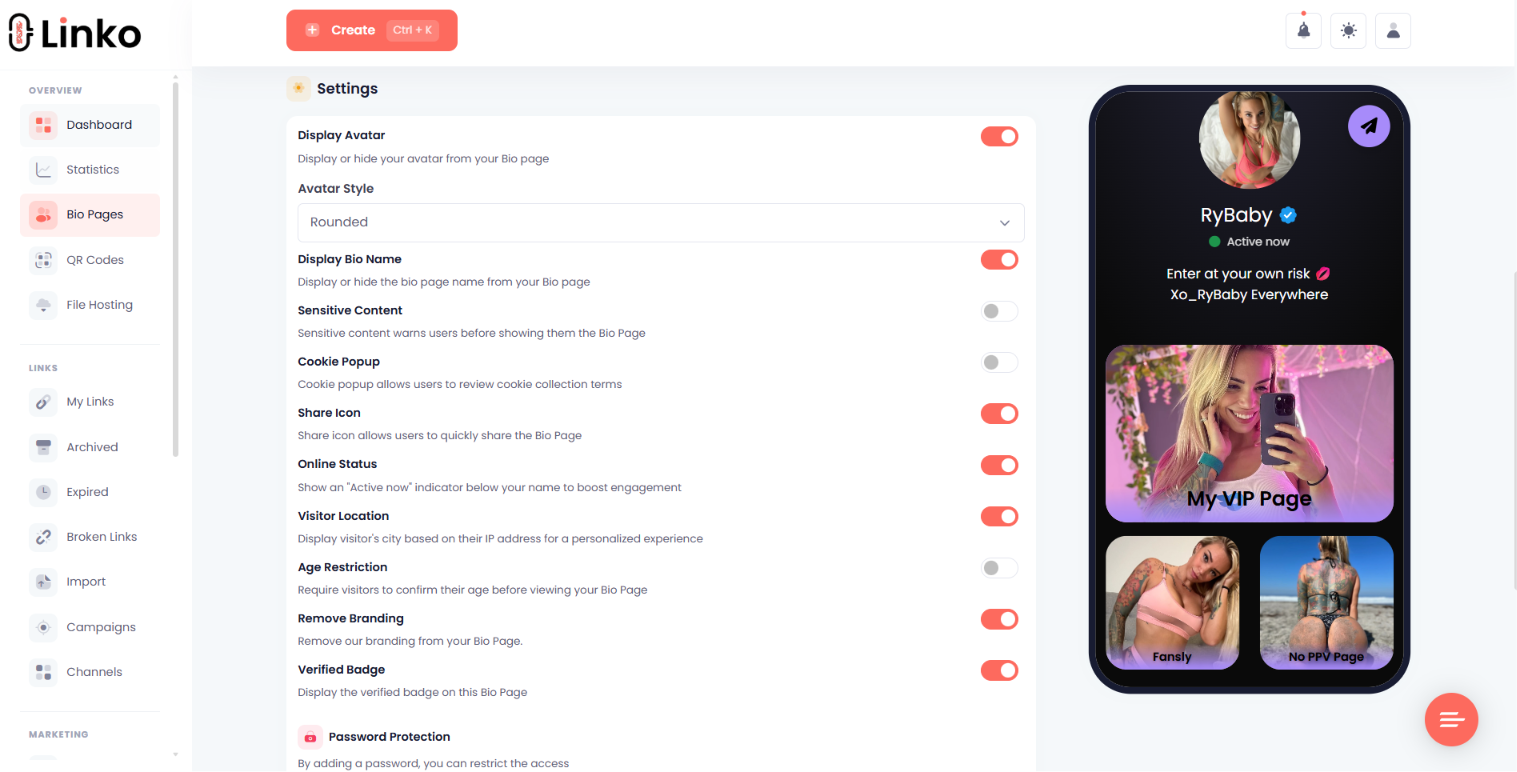
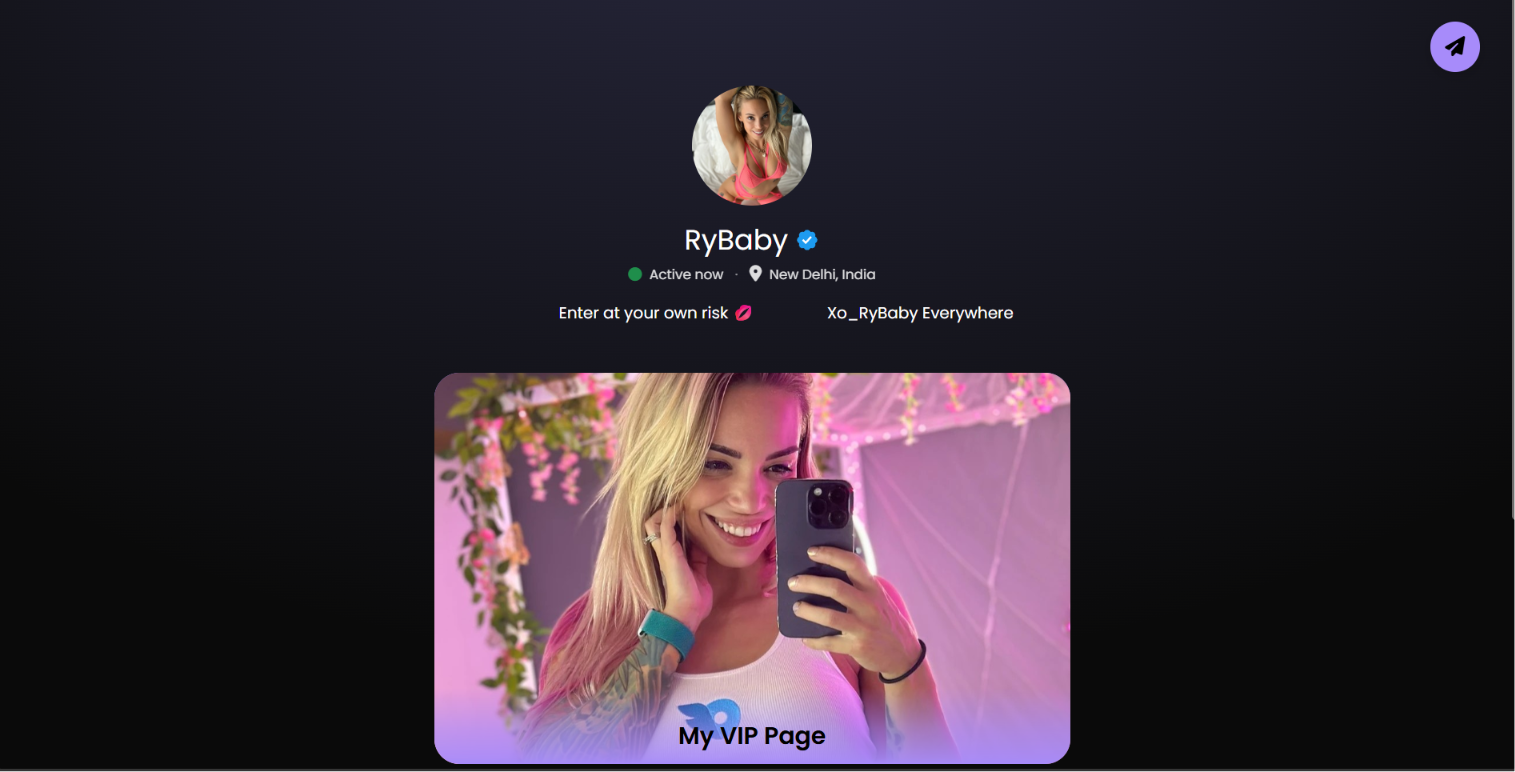

Full plan limits are on the Linko pricing page. If you want the setup built specifically around creator traffic, the OnlyFans marketer solution page walks through it, and you can test routing for free with the free OnlyFans URL shortener.
For the technical side of why an app opens instead of a browser, see our explainer on what deep linking is and how it works, or the platform specific walkthrough for creating an OnlyFans deep link.
Your Decision Checklist
Run through these in order. The first clear answer decides it.
- Does the platform forbid adult links? If yes, use a landing page. Instagram and TikTok fall here.
- Is the audience already warm? If yes, use a direct link. Telegram lists, email, and DMs fall here.
- Do you need an age gate or a content warning? If yes, you need a page, because a redirect cannot show one.
- Are you promoting more than one destination? If yes, use a page. A direct link handles exactly one.
- Do you need dwell time for a retargeting pixel? If yes, a page gives you more than a redirect does.
- Is your page slow or cluttered? Fix the page before blaming the routing.
- Still unsure? Run the two week split and let your own subscriber numbers decide.
Creators running several accounts should also read our roundup of OnlyFans marketing tools for agencies, since routing decisions get harder to manage once you pass a handful of models.
Frequently Asked Questions
Does a landing page reduce conversions?
Yes, it almost always reduces the number of people who reach your destination, because it adds at least one tap. Whether it reduces subscribers is a different question, since the visitors who do tap through are more qualified and can convert at a higher rate.
Can I use a direct link to OnlyFans on Instagram?
Technically you can paste one, but it matches the pattern Meta’s sexual solicitation policy prohibits, which names links to pornographic sites directly. Creators who do it report flags, reach loss, and account reviews, so most treat a landing page as the cost of staying on the platform.
Does a custom domain make a direct link safe?
No. A custom domain changes the visible URL, not the destination, and moderation systems follow the redirect. A branded domain is worth using for trust and control, but it is not a compliance fix on its own.
Is a link in bio page the same as a landing page?
For this decision, yes. Both put a page you control between the tap and your destination. A dedicated landing page usually pushes one offer, while a link in bio page lists several, and fewer choices generally means more conversions.
How many clicks should it take to reach my profile?
Two at most on strict platforms, and one everywhere else. Three taps is where creators report the sharpest drops, which usually happens when an age gate stacks on top of a sensitive content warning.
Why do my clicks look high but my subscribers stay flat?
Either bots are inflating your clicks, or your visitors are dropping at a step you are not measuring. Check whether your tool filters non-human traffic, then compare page views against destination visits to find the leak.
Should I show an age warning if the platform does not require one?
It costs conversions, so only add it when a platform rule, a local law, or your own risk tolerance calls for it. If you do add one, use a single gate rather than stacking two.
Which converts better for paid traffic?
A landing page, in most cases. Ad networks apply stricter review than organic feeds, and a page gives you the pixel fire, the dwell time, and the disclosure that direct redirects cannot provide.
Pick the Route Your Platform Allows, Then Fight for Every Tap
The direct link vs landing page debate gets treated as a conversion question when it is really a permission question.
On Instagram and TikTok, the rules make the choice for you, so put your energy into a fast page with one obvious button instead of resenting the extra step.
On X, Reddit, Telegram, and email, take the direct link and stop adding friction you were never required to add.
Then measure it. Run the two week split, compare subscribers rather than clicks, and trust your own numbers over any benchmark in this post or anywhere else.
If you want to run both routes and read them side by side, Linko’s Bio Pages and short links share the same analytics.
The free plan covers a first test, and adding your own branded domain starts on Starter.
Comments