
Have you ever copied a web address that looked like this?
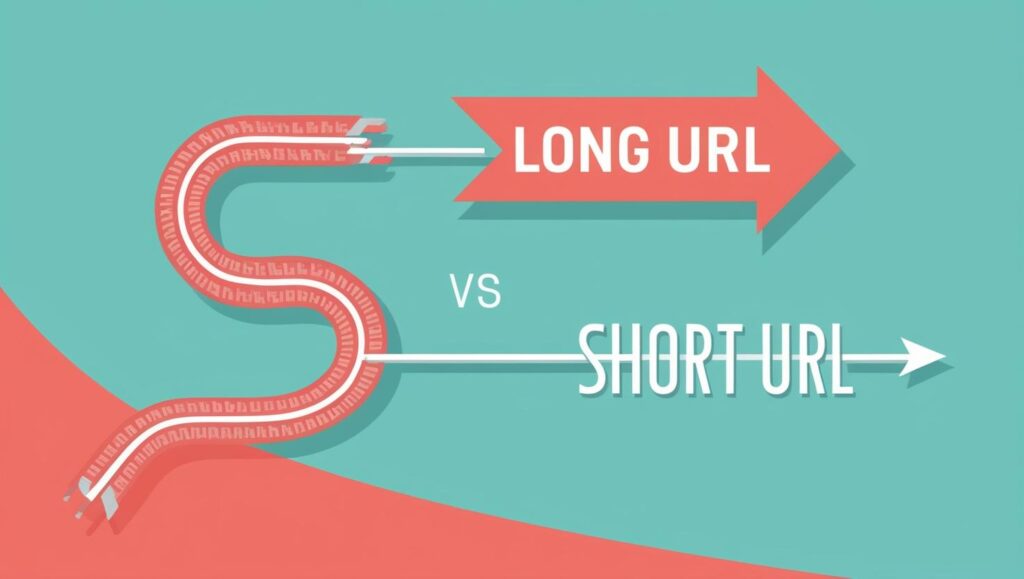
https://www.example.com/articles/category/technology/web-development/2025/02/the-future-of-url-shortening-and-its-impact-on-digital-marketingThat is the kind of address link shorteners were invented to fix.
A link shortener takes a long URL and hands back a short one that redirects to it.
The idea is older than most people assume, and it did not catch on because short links look tidier.
It caught on because long addresses kept breaking, and later because Twitter counted every character.
Shorteners stuck around for four reasons.
- Space: character limits on X and Bluesky make a 140-character URL unusable.
- Tracking: a redirect is a place to count clicks, which a raw link cannot do.
- Control: the destination can be changed later without reprinting the link.
- Appearance: a short branded link is easier to read aloud, type, and trust.
This guide follows how shortening started, which services shaped it, and what happened to the ones that did not last.
The Origins of URL Shortening
Long URLs were breaking in transit years before social media existed.
Email clients and Usenet newsgroup readers wrapped text at a fixed width, which split a long address across two lines and left the reader holding a broken link.
The first services built to solve that appeared in 2001, when MakeAShorterLink and SnipURL launched.
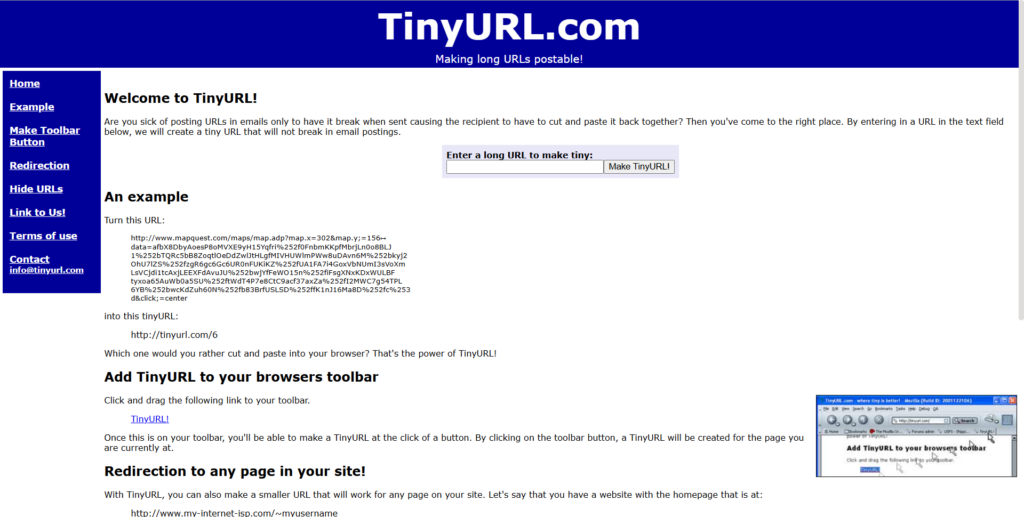
TinyURL arrived in January 2002, built by web developer Kevin Gilbertson so he could post links to newsgroups without them falling apart.
So TinyURL was not literally the first, but it was the first to reach a wide audience, and it is still running more than two decades later.
It worked the way nearly every shortener still works today.
- You paste a long URL into a form.
- The service files it against a short key, the few characters after the slash.
- Any request to that short link gets a redirect to the original address.
In 2008 TinyURL added custom aliases, so a link could read tinyurl.com/wp-tinyurl instead of a random string of characters.
That single change turned a shortener from a plumbing tool into a branding one, and every service since has copied it.
The Evolution of Link Shorteners
Once TinyURL proved people wanted this, the market filled up fast.
Here is the sequence of events worth knowing, before the individual services.
| Year | What happened | Why it mattered |
|---|---|---|
| 2001 | MakeAShorterLink and SnipURL launch | The first services built purely to shorten and redirect |
| 2002 | TinyURL launches in January | The first shortener to reach wide use, and still online |
| 2008 | Bitly launches, TinyURL adds custom aliases | Click analytics and readable slugs arrive together |
| 2009 | goo.gl and ow.ly launch, Twitter makes Bitly its default | Shortening becomes a feature inside larger platforms |
| 2010 | Twitter announces t.co, Bitly adds QR codes, Libya seizes vb.ly | Platforms take over the wrapping, and domain risk turns real |
| 2011 | t.co starts wrapping every link of 20 characters or more | Shortening shifts from a user choice to platform infrastructure |
| 2015 | Rebrandly launches | The branded domain becomes the product rather than an add-on |
| 2016 | Linktree launches | One link holding many links becomes its own category |
| 2018 | Google closes goo.gl to new users, T.LY launches | The biggest shortener retires while a new one fills the gap |
| 2021 | Linko launches in November | Shortener, bio pages, QR codes and file sharing ship in one account |
| 2022 | Dub is built at Vercel and open sourced | Links start being treated as attribution infrastructure |
| 2025 | Firebase Dynamic Links shuts down on 25 August | Google’s own replacement for goo.gl outlived it by nothing |
1. Bitly
Bitly launched in 2008 and became the default choice for marketers almost immediately.
Two things set it apart.
- Real-time click data, broken down by location and referring source.
- Custom domains, which let The New York Times publish links on
nyti.msinstead of a generic shortener.
Twitter switched its default shortener from TinyURL to Bitly in 2009, which put Bitly links in front of an enormous audience.
That advantage lasted about two years, until Twitter decided to wrap links itself.
2. Goo.gl
Google launched the goo.gl shortener in 2009 with the reach of Gmail, Google Analytics, and automatic QR code generation behind it.
It closed to new users in 2018, although existing links kept redirecting for years afterwards.
In July 2024 Google said every goo.gl link would stop responding after 25 August 2025.
That is not what happened.
On 1 August 2025 Google revised the plan and kept every link that was still being clicked, disabling only those with no recent activity.
So a large number of goo.gl links still work today, and if yours redirected without showing a warning page back then, it survived.
If yours did not, here is how to replace dead goo.gl links.
The replacement Google pointed developers toward has a sharper ending.
Traffic was steered to Firebase Dynamic Links, and Firebase Dynamic Links shut down on 25 August 2025, the very same day.
The lesson is not that Google is careless, it is that a short link you do not control is a dependency you cannot renew.
3. Ow.ly
Hootsuite launched ow.ly in 2009 as part of its social media management dashboard rather than as a standalone product.
Shortening, scheduling, and reporting sat in one place, so a social media manager never had to leave the tool.
That bundling set the pattern most platforms follow now, where the shortener is a feature of something bigger instead of the whole business.
4. Rebrandly
Rebrandly launched in 2015 from Dublin with a narrower bet than its rivals.
Rather than treat a custom domain as an upgrade, it made the branded domain the entire point of the product.
It also partnered with registrars so buying and connecting a short domain happened inside the same flow, which at the time was genuinely awkward everywhere else.
If you are weighing it up today, we have a detailed Rebrandly comparison, and the underlying question of branded versus generic links is worth reading first.
5. T.LY
T.LY started in 2018, and its origin says something about the moment.
Founder Tim Leland had built a browser extension for shortening links that grew past 400,000 users, right as Google was winding down its own shortener.
Rather than keep depending on other people’s services, he built the service underneath it.
Calling it a basic shortener undersells what it does now.
- Smart URLs that route by device, location, or browser from one link.
- CSV bulk import, including migration of existing links from another service.
- Extensions on five browsers plus apps on both mobile platforms.
The one thing to understand is the domain itself, which brings us to the part of this history most articles skip.
The .ly problem nobody planned for
Short domains are short because they borrow a country code, and .ly belongs to Libya.
In September 2010 Libya’s registry seized vb.ly, a shortener run from the United States, on the grounds that its content broke local rules.
The BBC reported that the registry also restricted .ly domains shorter than four characters to Libyan companies and residents.
Bitly, sitting on bit.ly, spent that week reassuring everyone it was safe, and it was.
The point stands anyway, because a borrowed country code means a registry in another jurisdiction can change the rules on links you have already printed.
6. Linktree and the link in bio era
In 2016 three people running a Melbourne digital agency got tired of rewriting the single link in their clients’ Instagram bios.
They built Linktree in an afternoon, and it created a category that did not exist before.
This mattered to shorteners because it redefined what a link is for.
A shortener compresses one destination, while a link in bio page holds many and becomes a destination itself.
Most link tools now sell both, because creators arrive wanting the bio page and discover they need the tracking.
7. Linko
Linko launched in November 2021, which makes it the newest name on this list.
It arrived after the link in bio boom rather than before it, and it was built on the assumption that a short link is rarely the only thing anyone needs.
One account covers four things that used to mean four subscriptions.
- The shortener, with editable destinations and branded domains.
- 14 QR code types, static and dynamic.
- Bio pages for the link in bio use case.
- File sharing with a download page you can brand.
Analytics filter out bot traffic on every plan including the free one, which matters more than it sounds when a scanner inflates your click count.
Targeting lives on the link itself, so one short URL can route visitors by country, device, or language.
Being straight about the gates, that link-level targeting starts on the Pro plan at $29 a month, and deep linking into apps starts on Business at $79.
8. Also worth knowing: Sniply, Cuttly, Dub, and Short.io
Four more services fill particular gaps.
- Sniply adds a call to action overlay on the page you link to, so you get a conversion opportunity on somebody else’s content.
- Cuttly keeps the interface plain and the analytics detailed, which suits people who want metrics without a platform.
- Dub was built at Vercel in 2022 and open sourced, and it is aimed at attribution rather than shortening, tracking clicks through to conversions and affiliate payouts.
- Short.io concentrates on branded domains at scale with a wide set of integrations.
Dub is the one to watch conceptually, because treating a link as an attribution record rather than a redirect is where this market is heading.
The Role of Social Media in Popularizing Short Links
Social platforms did not just adopt shorteners, they forced them into the mainstream and then absorbed them.
Twitter’s character limit
With 140 characters to work with, a long URL could eat half a message before you wrote a word.
Twitter’s default shortener changed hands twice in three years.
- Until 2009: TinyURL, the incumbent.
- 2009: Bitly, which gained an enormous audience overnight.
- 2010 onward:
t.co, built in house, which ended the arrangement.
Why Twitter built t.co
Twitter announced t.co in June 2010, and from August 2011 it wrapped every link of 20 characters or more.
Saving space was only part of it, because the company’s own explanation put malware and phishing first.
A shortened link hides its destination, which is useful for tidiness and equally useful for fraud.
Routing every link through t.co let Twitter check destinations against a blocklist before a reader ever arrived.
What the platforms took with them
Once platforms wrapped links themselves, third-party shorteners lost the character-count argument entirely.
What they kept was the part platforms would never hand over, which is your own data about who clicked.
That is the reason the industry survived the thing that was supposed to kill it.
Technological Advances in URL Shortening
A modern shortener has very little in common with the 2002 version beyond the redirect itself.
- Custom aliases and branded domains put your name in the link, as in
yourbrand.com/spring. - Editable destinations let you repoint a printed link after the fact, which is the feature people underrate most.
- Analytics now cover location, device, browser, language, referrer, and time of day rather than a single click total.
- APIs allow links to be created by software, which is how ecommerce stores generate thousands without anyone opening a dashboard.
- QR codes made the same short link work offline, and most tools now generate a QR code alongside every link.
- Deep linking opens a destination inside a phone app instead of a browser tab, which is a separate technique worth understanding.
Bitly added QR codes back in October 2010, so the offline bridge is older than the recent enthusiasm suggests.
Link Shorteners in Digital Marketing
The marketing case for a shortener comes down to what the redirect lets you measure and change.
Attribution you actually own
A tracked link records the click on your side, independent of whichever platform sent it.
Pair it with ?utm_source= parameters and the same click shows up in your analytics with the campaign attached.
If you want the numbers behind adoption and click behaviour, we keep a separate page of url shortener statistics.
Brand consistency
A link on your own domain tells the reader who they are trusting before they click.
That is the whole argument for branded links, and it is the reason generic shortener domains now get filtered by some email providers.
What shorteners do not do for SEO
This is worth stating plainly, because a lot of writing on the subject is wishful.
A short link is not a ranking factor, and adding one does not improve how a page ranks.
A permanent 301 redirect does pass ranking signals through to the destination, so a shortened link is not throwing value away either.
Even so, when you earn a backlink worth having, ask for a direct link to the page rather than a shortened one.
Use shorteners for campaigns you want to measure, not for links you want search engines to weigh.
The Future of Link Shortening
Most predictions written about this topic a few years ago have already come true, so it is more useful to say what is now standard and what is genuinely unsettled.
Already standard, and no longer a differentiator:
- One link routing to different destinations by country, device, or language.
- Editable destinations and expiry dates on a link you have already shared.
- Malicious link scanning, which platforms now expect from any shortener they do not block.
Still genuinely open:
- Attribution beyond the click. Connecting a click to a signup or a sale is the direction Dub and others are pushing, and nobody has made it simple yet.
- In-app browsers. Social apps increasingly open links inside their own browser, which breaks logins and complicates tracking, and the workarounds are unreliable by platform.
- Who owns the redirect. The goo.gl and Firebase shutdowns showed that a free shortener is a dependency, and self-hosted or custom-domain setups exist partly because of that.
The safest prediction is dull, which is that short links stay boring infrastructure and the competition happens in the reporting layer on top of them.
Conclusion
Link shorteners began as a fix for a formatting annoyance in newsgroup posts and email clients.
Twitter’s character limit made them mainstream, then Twitter replaced them with its own wrapper and they survived anyway, because the redirect turned out to be worth more as a measurement point than as a space saver.
The services that lasted are the ones that gave people something to own, whether that is a branded domain, their own analytics, or a bio page.
The ones that disappeared, goo.gl and Firebase Dynamic Links included, were free features inside somebody else’s roadmap.
If you are choosing one now, the honest summary is that the shortening itself is solved and interchangeable, so judge on the three things that are not.
- The reporting. Everyone counts clicks, so look at whether bots are filtered and how long the data is kept.
- The domain. A branded domain you own is the only version of this you can move between providers.
- The odds it survives. Ask whether the shortener is the business or a free extra inside somebody else’s roadmap.
Our comparison of link shortener tools goes through the current options, and you can try Linko’s link management on the free plan if you want to test one without a card.
FAQs
What is a link shortener?
A link shortener turns a long URL into a short one that redirects to the original page. The redirect also gives you a place to count clicks, which a plain link cannot do.
Who created the first link shortener and why?
MakeAShorterLink and SnipURL came first in 2001, but TinyURL, built by Kevin Gilbertson in January 2002, was the first to reach wide use. He created it so long addresses would stop breaking when posted to Usenet newsgroups, where readers wrapped text at a fixed width and split links across two lines.
Do goo.gl links still work?
Many of them do. Google originally said all goo.gl links would stop working after 25 August 2025, then revised that on 1 August 2025 and preserved links that were still receiving clicks. Only links with no recent activity were disabled, and the shortener has not accepted new links since 2018.
What replaced Google’s URL shortener?
Google pointed developers to Firebase Dynamic Links, which then shut down on 25 August 2025, the same date set for the goo.gl cutoff. There is no Google-run replacement now, so anyone needing short links uses an independent service or their own domain.
Why do so many shorteners use .ly domains?
Because .ly is Libya’s country code and makes for very short, readable names like bit.ly and t.ly. The trade-off is jurisdiction. Libya’s registry seized the vb.ly shortener in September 2010 and restricted .ly domains under four characters to Libyan companies and residents.
Can link shorteners improve my SEO?
No, a short link is not a ranking factor. A permanent 301 redirect does pass ranking signals to the destination, so shortened links do not waste value, but for a backlink you actually want to count, ask for a direct link to the page instead.
Are short links a security risk?
They can be, because the short version hides where it goes, which is exactly what phishing relies on. This is why Twitter routed everything through t.co and screened destinations against a blocklist. Use a service with link scanning, and prefer branded domains so readers can see who the link belongs to.
What happens to my links if a shortener shuts down?
They break, and there is usually nothing you can do after the fact. That is the real lesson of goo.gl and Firebase Dynamic Links. Using your own branded domain protects you, because you can repoint the domain at a different provider and keep every published link working.
Comments