
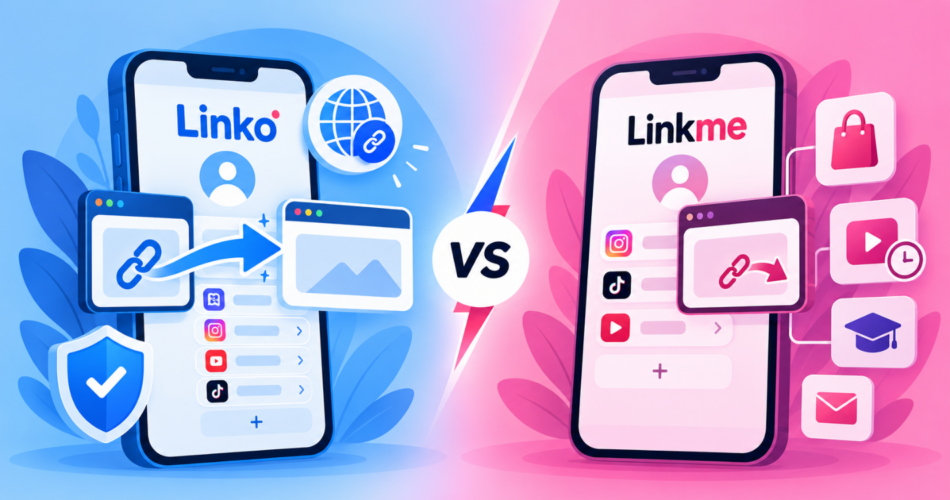
Link.me sells deep linking on a $29.99 plan.
Linko gates the same category of feature to $79.
That gap is real, and any comparison that skips it is not worth reading.
But Linkme’s pricing page also promises that its Deeplink technology opens links in Safari and Chrome rather than in-app.
We tested that, and it did not happen.
Here is what we found, what Linkme genuinely does better, and a one-minute check you can run yourself.
Key Takeaways
- Linkme is a creator business platform, with shops, courses, email, social scheduling and Instagram automations that Linko does not offer.
- It advertises deep linking at $29.99, where Linko charges $79, though the plans bundle very different amounts of product.
- Every Linkme link we opened from Instagram stayed inside Instagram’s browser, and creators report the same.
- Neither Linkme nor Linktree offers a custom domain, so your page sits on a shared one.
- Linkme has native iOS and Android apps. Linko has a Chrome extension and a Telegram bot.
What Is Linkme, and What Does It Do Well?
Precision matters here, because two other products have similar names.
Linkme runs at link.me and is operated by Me Global App Inc.
It is not HeyLink.me, and it is not linkme.bio, both separate products.
It is not really a link tool
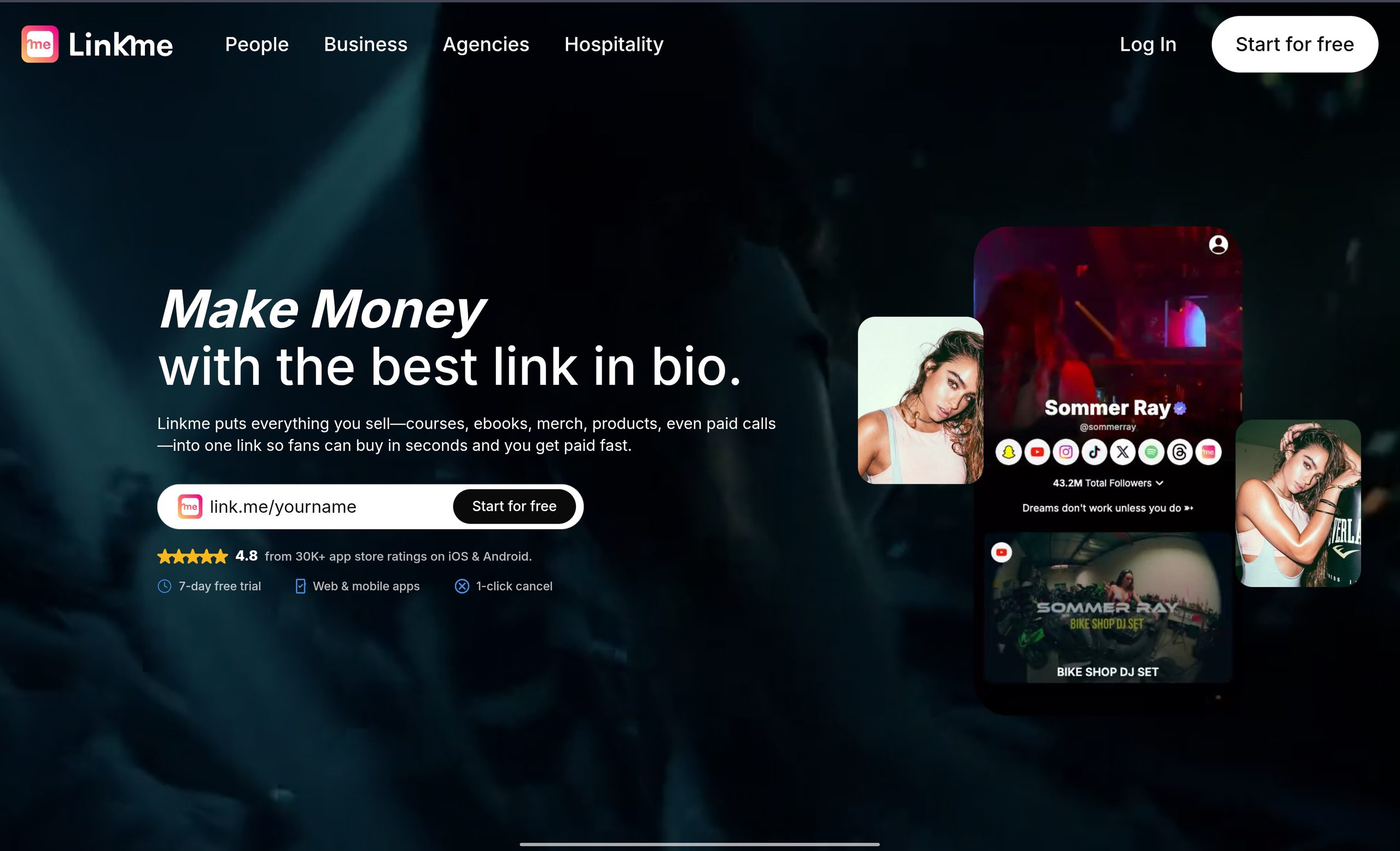
Linkme’s own platform summary describes building a link-in-bio presence, publishing social content, automating engagement, and selling online.
The bio page is the front door rather than the product, which explains most of the differences below.
Where it genuinely beats Linko
This list is substantial, and pretending otherwise would waste your time.
- Post to All publishes or schedules across YouTube, Instagram, TikTok, Facebook, X, Threads and LinkedIn.
- Instagram automations trigger on keywords or comments with automated replies and DM sequences.
- Shops and courses sell merch, digital products and video lessons with checkout, including print on demand.
- Email lists and campaigns are built in.
- Native iOS and Android apps, rated 4.8 from roughly 5,200 iOS reviews.
- Multi-profile management with roster-wide analytics for agencies.
- 40 languages, and weekly billing that Linko does not offer.
Linko has none of the first four.
It routes and measures traffic rather than selling, scheduling or automating.
Who it suits
Creators in the community describe Linkme as fitting people with several platforms to promote, such as YouTube and TikTok alongside everything else.
That is a different job from pushing one paid destination as hard as possible.
The Deep Link Claim, Tested
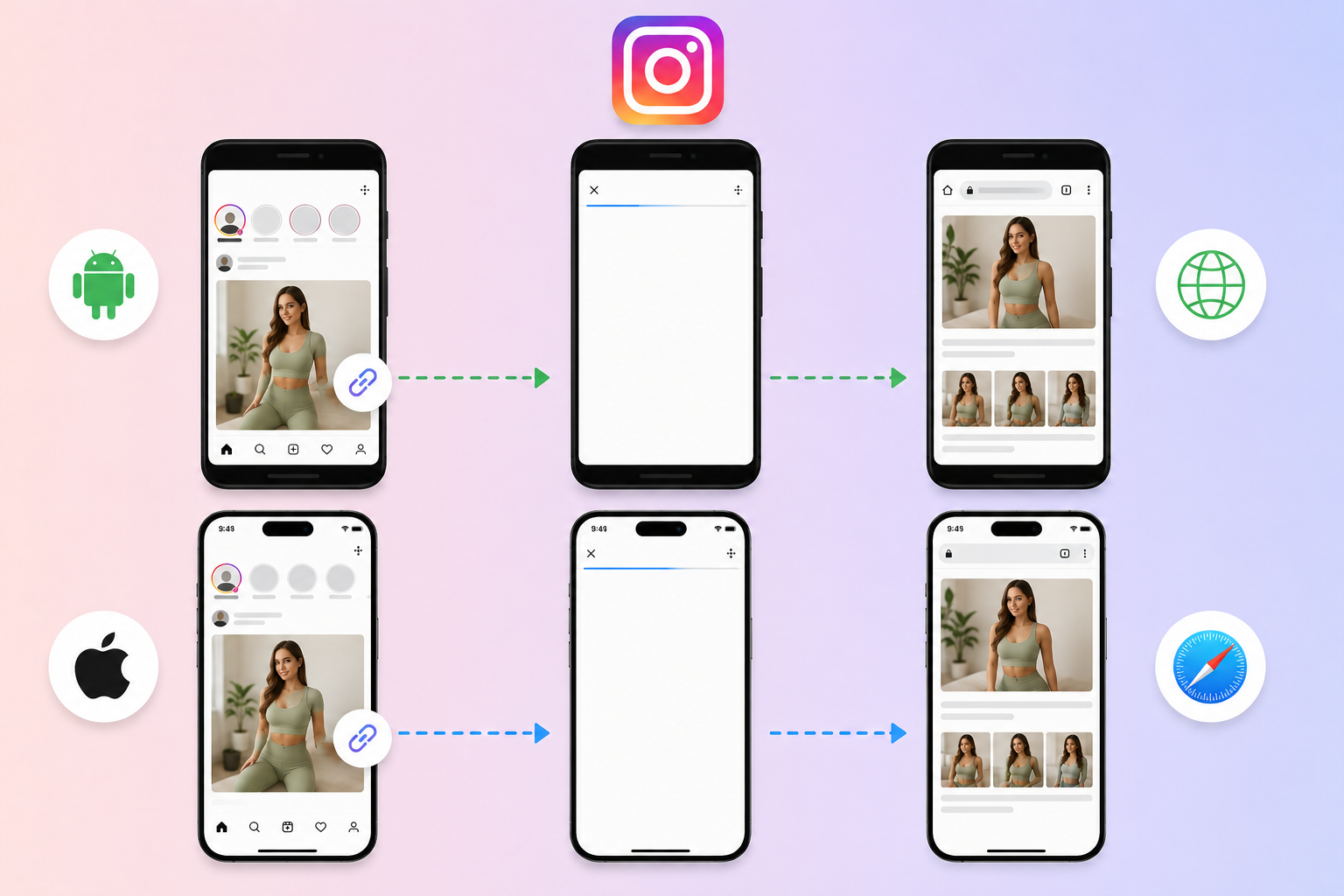
Linkme’s pricing page lists Deeplink technology under its Pro plan, described as opening links in Safari and Chrome rather than in-app.
What we found
We opened a large number of live Linkme links from Instagram on real phones.
Every one loaded inside Instagram’s in-app browser instead of handing off to Safari or Chrome.
What creators report
The community reports match what we saw:
- That Linkme links still open inside Instagram’s browser.
- That Linkme stopped using deep links at some point in March 2026.
- That putting Linkme in front of another tool loses conversions because the escape never happens.
- That it shows a helper box explaining how to open the page in a browser manually.
That last detail is the tell, because a box asking the visitor to do it themselves is not an automatic escape.
What we can and cannot state
- Verified: the feature is advertised on Pro.
- Verified by our testing: the links we opened stayed in-app.
- Verified: creators report the same independently.
- Not verified: which plan each tested link was on, since Deeplink technology is Pro-only.
That last line is the honest limit, and it cuts both ways.
Links on Free or Plus accounts would not be expected to escape at all.
Behaviour also differs between iOS and Android, and Instagram has changed how it treats handoffs more than once.
So the defensible conclusion is narrower than “it does not work” and more useful than “it does”.
The advertised behaviour and the observed behaviour do not match, and that difference costs you money if you trust the marketing.
The one-minute test
- Put the link in an Instagram bio, or send it to yourself in an Instagram DM.
- Open Instagram on a phone and tap it.
- Look at where you land.
Three outcomes, three meanings:
- Safari or Chrome opens. The escape works and price becomes your deciding factor.
- An instruction box appears. Treat that as no escape, because most visitors will not follow steps.
- Nothing changes. The feature is not delivering, whatever the pricing page says.
Run it on every tool you are comparing, including Linko.
Why the In-App Browser Decides This
If you sell anything behind a login or a payment, this is not a minor technical detail.
What breaks inside it
- Login state. Your visitor is usually not signed in, even with an account.
- Saved passwords. Managers such as
iCloud Keychainoften fail there. - Stored payment methods. A card saved in Safari is unavailable.
So someone ready to subscribe now has to type an email, a password and a card number on a phone.
Most of them do not.
Why paid funnels feel it hardest
If your bio link ends in a free page, the browser barely matters.
If it ends in a paywall, the browser is the conversion step.
We cover the mechanics in getting out of in-app browsers and the creator version in opening creator links in Safari from Instagram.
Linko’s deep linking covers 28 platforms including OnlyFans, Fanvue and Fansly, on Business and Agency plans only.
The underlying concept is explained in what deep linking is.
The Two Gaps That Matter for Creator Funnels
Linkme has no custom domain
I checked its homepage, pricing, agencies, business and FAQ pages, and none mention one.
Its “Custom branding” feature swaps the Linkme mark for your logo, which is branding rather than a domain.
So every page sits on the shared link.me domain, with three consequences:
- Shared fate. If the domain is restricted anywhere, every user is affected at once.
- No portability. Your URL is
link.me/username, so leaving means changing it everywhere. - No reputation of your own to build or protect.
That is the same structural limit Linktree has, covered in our Linktree comparison.
Linko includes branded domains from Starter at 2, rising to 5 on Pro, 20 on Business and 50 on Agency, and why that matters is the subject of our guide to a custom domain for creator links.
Linkme does not advertise bot filtering
Nothing on its public pages describes bot detection, crawler filtering or a protective page for suspicious traffic.
Creators also note it does not block VPN or proxy traffic.
Linko filters clicks through a nine-layer system before counting them, including 1,500+ bot patterns, a blacklist of over 900,000 bad IP addresses, datacenter blocking and hourly deduplication.
Shield Protection, which shows suspicious traffic a neutral page, starts on Starter for both Bio Pages and short links.
One honest caveat: any filter this strict occasionally catches a real visitor on a VPN, which we explain in bot traffic in link analytics.
How Do the Prices Compare?
Linkme’s pricing page renders in the browser, so these come from its Apple App Store subscription disclosure.
| Linkme | Monthly | Linko | Monthly |
|---|---|---|---|
| Free | $0 | Free | $0 |
| Plus | $9.99 | Starter | $12 |
| Pro | $29.99 | Pro | $29 |
| Weekly options | $2.99 to $9.99 | Business | $79 |
What each price actually buys
On headline numbers Linkme is cheaper at both tiers, but the plans are not the same amount of product.
Linkme’s money goes into selling and publishing.
Linko’s goes into link infrastructure, so its $12 Starter plan adds this to the bio page:
- 250 short links a month with editable destinations.
- 2 branded domains, which Linkme does not offer at any price.
- QR codes and file sharing with download analytics.
- Tracking pixels, channels, promo pages and CTA overlays.
- Shield Protection and bot-filtered click data.
So neither company is simply undercutting the other.
Price the stack you would actually run.
Paying Linkme for the page and then buying a separate branded shortener and QR tool puts you above Linko’s $12.
Equally, assembling a storefront, scheduling and DM automation from separate tools would cost far more than $29.99.
Full Linko limits are on the pricing page.
What Do Their Rules and Privacy Terms Say?
Linkme’s Community Standards permit links to adult content that is legal in your region, marked sensitive, and not advertising full service sex work.
You may also advertise adult media you create and sell elsewhere.
For anyone comparing the two, that wording is materially the same as Linktree’s policy.
Its enforcement section notes that Trust and Safety may remove links, delete images, or apply sensitive content warnings.
Worth weighing separately is what Linkme discloses about tracking.
Its App Store privacy labels list usage data used to track you across other companies’ apps, plus location, contacts, user content, search history and browsing history linked to your identity.
For creators who separate identities carefully, that is a real factor.
Which One Fits You?
These products barely compete on the same axis, which makes the choice clearer than usual.
Choose Linkme if
- You want to sell products, courses or merch from your bio page.
- You want social scheduling across seven platforms in one tool.
- You want Instagram DM automation from keywords and comments.
- You want a native mobile app.
- You are a multi-platform influencer rather than running one paid funnel.
Choose Linko if
- You need your own domain.
- You need links to reliably escape the in-app browser, verified by your own test.
- You need bot-filtered analytics rather than raw totals.
- You manage several creators and need client editing, permissions and domain separation.
- You want short links, QR codes and file sharing in one account, or an API for volume.
The case for using both
Some creators run Linkme for the storefront and a separate layer for routing and measurement.
That is legitimate, not a contradiction.
Just watch the stacking, because every extra hop costs conversions and blurs attribution, as covered in our guide to tracking creator traffic.
Frequently Asked Questions
Does Linkme have deep linking?
It advertises Deeplink technology on its Pro plan, described as opening links in Safari and Chrome.
In our testing the links stayed inside Instagram’s browser and creators report the same, so verify it on your own account before depending on it.
Can I use a custom domain with Linkme?
Not according to anything published on its site.
Its homepage, pricing, agencies, business and FAQ pages make no mention of one, and Custom branding replaces the logo rather than the domain.
Is Linkme cheaper than Linko?
On headline numbers yes, at $9.99 against $12 and $29.99 against $29.
The scope differs though, since Linko bundles short links, QR codes, file sharing and branded domains, so compare the total cost of the stack you would run.
Is Linkme good for OnlyFans creators?
Its rules allow legal adult links that are marked sensitive and do not advertise full service sex work.
The practical concerns are the shared domain, no published bot filtering, and the gap between its deep linking claim and what we observed.
Is link.me the same as HeyLink.me or linkme.bio?
No, all three are separate products, and this compares link.me by Me Global App Inc.
Can I move away without losing traffic?
Keep the old page live pointing at the new one, change one account first, then watch outcomes for a week before updating the rest.
Test the Claim, Then Pick the Tool
Linkme is a stronger product than a feature list suggests.
It sells, schedules, automates and ships mobile apps, at a lower headline price.
For a multi-platform creator building a storefront, it is a reasonable answer.
What it did not give us is a domain of your own, published bot filtering, or a link that escaped Instagram’s browser.
Those three only matter if your revenue depends on a visitor arriving logged in and ready to pay.
If it does, run the one-minute test on both tools before committing.
Then build on whichever one actually got you out of that browser, and you can try Linko’s Bio Pages free while you compare.
Comments